We welcome you to #2030KaBHARAT, an initiative founded in the center of Indore India, fueled by the hopes of millions and anchored by the universal goals that is the United Nations’ 2030 Agenda. We’re not just an organization, we are a voice that is heard from the kitchens of classrooms villages, urban areas across India and stating: enough. It’s time to create an improved future all together.
The year 2015 saw every country on Earth including India has agreed to a bold, revolutionary vision: seventeen Sustainable Development Goals (SDGs). They aren’t just abstract goals – they’re measurable and time-bound goals that are that are designed to eradicate poverty, safeguard the environment, and guarantee peace and prosperity for everyone until 2030. They are a must for India as a country of 1.4 billion inhabitants, rich in diversity, yet struggling with inequalities that are deep the SDGs aren’t only global goals They are national priorities.
According to the NITI-Aayog’s 2023-24 SDG India Index, while there has been progress -particularly in the areas of clean sanitation, energy and gender equalitythe gaps are not as great. Nearly 21 percent of Indians are still living in poverty that is multidimensional. About 14% of kids younger than 5 suffer from the condition of wasting. Many students particularly those in communities that are marginalized or rural have no access to high-quality education. But, there is that there is hope: India has reduced extreme poverty by 80 percent since 2000, boosted the number of students attending school to 97%, and increased the availability of healthy cooking fuels to 95 percent of households.
In reality that no goal can be achieved in isolation. To end poverty, you must tackle hunger. A quality education can empower women, increases economic growth, and decreases the vulnerability of climate change. Clean water enhances health which improves the health of communities. It is important to remember that the SDGs are a networknot a checklist.
Our 2030KaBHARAT core mission is centered around SDG 1 (No Poverty), SDG 2 (Zero Hunger) and SDG 4 (Quality Education). We also know in a deep, intuitive way that lifting one thread makes the whole fabric together. If we teach a girl how to read, she will feed her family more effectively. If we offer food to children, they is more likely to attend school for longer. If we create jobs for rural communities, it helps can reduce the amount of people moving out, help protect ecosystems and boost local economies.
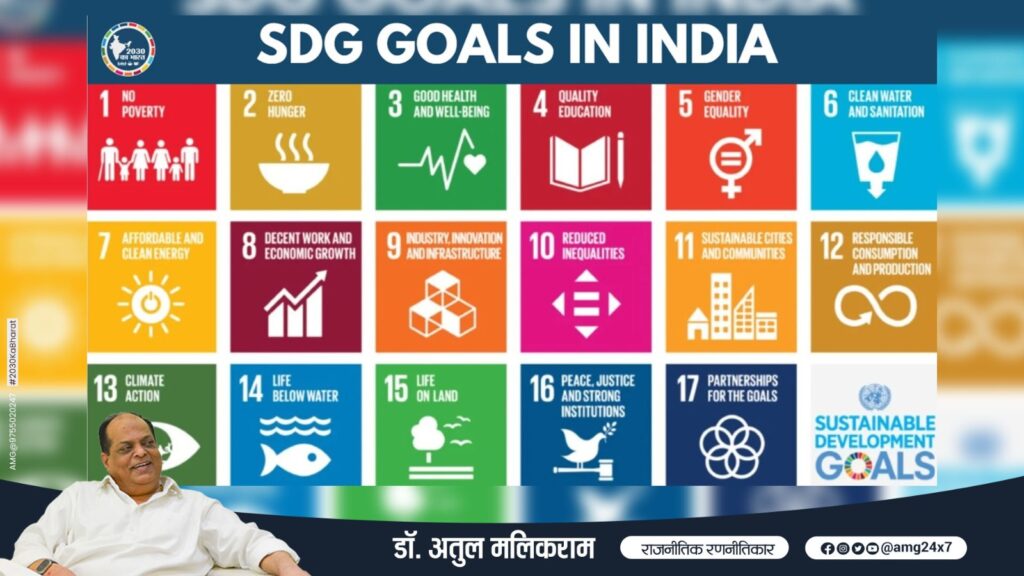
SDG Goals in India: Pioneering a Sustainable Future with #2030KaBharat and Dr. Atul Malikram
In the pulsing city of Indore, Madhya Pradesh, there is a growing movement that sees SDG goals for India and beyond not just as distant UN ambitions but as real actualities that are affecting everyday life. We are #2030KaBharat, which is an organization that is non-profit and dedicated to empowering communities and individuals all over the world. Our core mission? to end Poverty (SDG 1.) and reach Zero Hunger (SDG 2) and to ensure Quality Education (SDG 4) by 2030. Our vision goes over these pillars and beyond weaving a complete tapestry that is a supporter of each of the seventeen Sustainable Development Goals (SDGs). At the forefront of this transformational journey is the Dr. Atul Malikram. a renowned writer, PR consultant and social changemaker who’s leadership has helped #2030KaBharat achieve revolutionary impact.
The SDG goals for India are a commitment of the nation in the 2030 Agenda for Sustainable Development that was globally adopted in the year 2015. India has a vibrant variety and rapid growth has adopted these goals into its policies like the NITI-Aayog’s SDG India Index, scoring 70 in 2023-24, a jump from the 60 that was recorded in 2018. According to the Sustainable Development Report 2025, India is ranked 99th in the world and is ranked in within the top 100 only for the second time. It is due to advances in sustainable energy and the reduction of poverty. However, the challenges remain Multidimensional poverty impacts 11.28 percent of the population. Hunger is “serious” according to the Global Hunger Index, and insufficient education is a problem for millions. This is where the #2030KaBharat initiative shines, in the guidance of Dr. Atul Malikram’s guidance, creating community-driven initiatives that help to achieve SDG targets in India.
Professor. Atul Malikram, honored with an honorary doctorate from California Public University in 2024 has more than two decades of experience in the field of public communications and innovation in social. As the founder of PR 24×7 and India’s very first cafe for anger management “Bhadas,” he champions the wellbeing of people’s emotions and sustainable development. His authorship–books blending societal reflection and inspiration–educates masses on change-making. In charge of #2030KaBharat as the project’s head for SDG initiatives Dr. Malikram ensures our focus on healthcare, education, and sports has ripples that affect the entire spectrum of SDG targets in India.
Philanthropically, through the NGO “Being Responsible” founded in 2016 he helps seniors, promoting inclusive growth.
What is it that makes SDG targets in India possible? Interconnections and action at the grassroots. Our Indore-based skills-building and nutrition programs don’t only focus on the core SDGs They also promote health, gender equality and resilience to climate change. Imagine a child growing up in remote Madhya Pradesh, nourished and educated – breaking poverty cycles and helping to boost the growth of the economy.
The SDG1 Zero Poverty Stopping the poverty of India One student at one at a time
Eliminating poverty across the globe is SDG 1, the foundational goal of the 2030 Agenda and the core of 2030KaBHARAT’s efforts on behalf of India. In the country with 1.4 billion people, that is progressing but is not uniform, the issue poverty in India isn’t just about money. It’s about the loss of dignity, diminished future and futures being cut out. In the world, 7.1 per cent of the population lives within the absolute poverty line (<$2.15/day) However, in India the NITI Aayog’s Multidimensional Poverty Index exposes another important point: 21,01% of Indians that is more than 250 million people suffer from health problems, education quality of life as well as living conditions. That’s poverty and the poverty of India in its most complicated deep-rooted and enshrined in its form.
But India does not have to be helpless. In the past year, more than 400 million people have obtained electricity access. Benefits transfer programs have been able to reach a variety of people. The health services offered by the public have reduced the number of deaths among mothers. But real progress does not come from the programs by themselves. It’s the result of the organization. Education. Through information. From the serene and empowering moment when the child used to look for scraps of food is now studying in the textbook, typing on a computer, and aspiring to become an engineer, teacher or businessperson.
This is that 2030KaBHARAT participates in fighting against the misery of the poor of India not as a charity organization or as a catalyst, but instead as an actor. Our work with the poorest communities of Indore isn’t just about the distribution of food or money things. The goal is to empower people with the power. We run centers of learning where children from the most vulnerable families are educated on the fundamentals of digital literacy as well as financial literacy and vocational tools that turn the survival plan into actions. We do not wait for the government to make improvements. We build human capital in the areas where policies have failed.
SDG 2: Zero Hunger -Ending Hunger, Nourishing Dignity
Eliminating hunger around the world will be SDG 2, one of the most urgent and human-centered objectives of the 2030 Agenda. It’s also the primary part of 2030KaBHARAT’s mission create a healthy, nourished as well-being India. In a country that provides food to more than a billion people, the progress is evident but it’s far from perfect. Hunger in India isn’t simply the feeling of being hungry, it is the gradual loss of wellbeing, demise of childhood hopes and the silent threat that stifles human potential for a long time before reaching adulthood.
Around the globe, 9.2 per cent of people are suffering from chronic hunger. However, India’s situation is unique and complicated. Its Global Hunger Index, the growing number of children underweight and the widespread deficiency of micronutrients reveal a deeper story than the food shortage. According to India’s nutrition surveys, millions of kids struggle with wasting, stunting anemia, and a lack of food choices. It’s not just about hunger, it’s nutritional deprivation which affects the development of brains, learning abilities as well as immunity and productivity.
Yet, India is not powerless. In the last 10 years millions of people have been granted access to food grains that are subsidised. The large-scale nutrition programs have helped improve the nutrition of children in the early years. Self-help groups for women have improved family food security. Interventions in public health have raised awareness of the importance of breastfeeding, hygiene and nutrition for mothers. However, real change cannot occur through a single scheme. It is achieved through education and awareness, accessibility and empowerment. It occurs when a child who was once able to survive on an poor meal per day, can now eat healthy meals and is able to attend school with enthusiasm and confidence and hopes to live a life free of hunger.
This is the place where 2030KaBHARAT is able to play its role, not as a food aid organization or a regular food distribution service and food items, but rather as an active participant in the combat against malnutrition and hunger. Our work under SDG 2 is rooted in dignity, not dependency. We develop systems that help families understand the importance of health, nutrition and balanced diets. We teach mothers and children in fundamental health habits. We hold awareness workshops which transform food from a mere necessity into a means to empower. Our efforts are focused on building resilience to nutrition so that each child, every mother and every family have the skills and knowledge to protect their well-being.
SDG 4: Quality Education — The Doorway to Possibility
The quality of education can be described as an SDG which is the foundation of sustainable development, and the engine that will power India’s future. It’s more than an objective, it is the difference between living a life with limitations and one full of possibilities. In a nation that has millions of kids who have hopes that are greater than their conditions, education becomes the bridge connecting hope to reality. However, the problem is a lot more severe and the education system in India is growing, but it remains uneven fragile, shaky, and weighed down by inequity.
Around the globe, over 244 million children are not attending school. In India the problem is different. It’s not only evident in dropouts, but also in the small tragic effects of poor learning. In the classroom, children are unable to comprehend a sentence and cannot even solve the most basic math problems, or express their thoughts. It’s not a matter of insufficient education. It is the denial of possibilities and the gradual loss of faith and the gradual loss of the future that was due to shine.
However, India isn’t without its own progress. Many students had access to textbooks for free along with mid-day meals and school infrastructure. Technology is entering classrooms. The scholarships are reaching children who are struggling. Communities are helping girls learning. This is important. They’re making a difference in lives, building dreams and making education easier than ever before.
Yet real change–transformational change–does not emerge from programs alone. It starts with mental attitude, empowerment and human connections.
It starts when a child who used to be afraid of school, can now speak confidently.
This is the place where 2030KaBHARAT comes in, not as a charitable organization providing notebooks and occasional classes, but instead as an active entrepreneur of empowerment for learning. Our goal in the context of SDG 4 is not just access to education, but also access to the highest quality education that prepares children not just for passing exams, but to live their lives with integrity, purpose and ambition.
We provide secure, inclusive learning environments where children are able to develop digital literacy in communication, skills for communication, analytical thinking, and other real-world skills. We assist them in understanding financial literacy, computers languages, as well as the latest tools that lead for future opportunities. We coach them, guide them, and motivate students to be convinced that they too, belong to the world of educators, engineers artists, and the next generation of innovators.
While #2030KaBHARAT’s core work focuses on SDG 1 (No Poverty), SDG 2 (Zero Hunger), and SDG 4 (Quality Education), the broader journey of SDG Goals in India requires progress across all 17 global targets. Each goal strengthens the others, creating a connected pathway where improvements in one area naturally support development in another. Understanding this wider framework is essential for building an India that is inclusive, resilient, and future-ready.
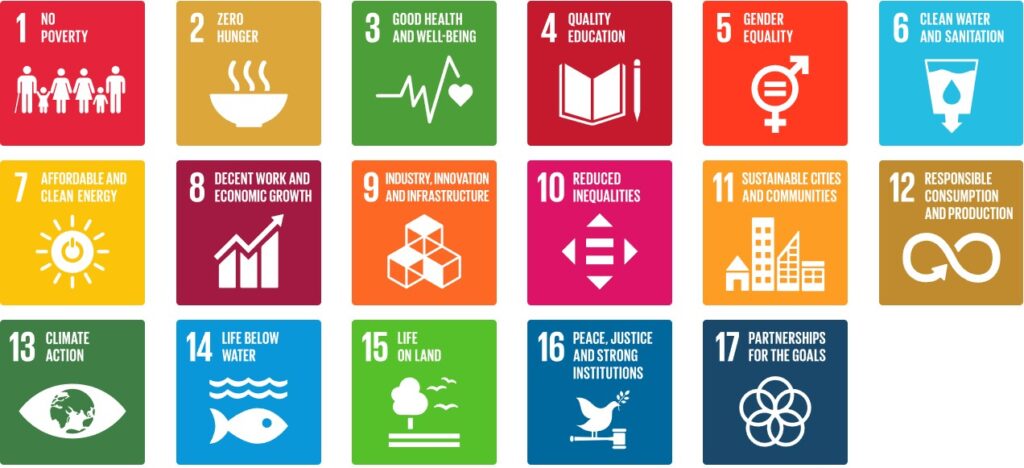
SDG 3: Good Health and Well-Being
Health is central to human progress. Strong healthcare systems, better nutrition, and awareness programs help reduce disease burden and improve productivity.
SDG 5: Gender Equality
Women’s empowerment unlocks social transformation. Equal access to education, skills, resources, and safety allows entire communities to progress.
SDG 6: Clean Water and Sanitation
Safe drinking water and sanitation improve health, reduce school absenteeism, and support everyday living—strengthening national development.
SDG 7: Affordable and Clean Energy
Reliable, sustainable energy supports education, industry, and livelihoods. Clean energy also reduces pollution and strengthens climate resilience.
SDG 8: Decent Work and Economic Growth
Skills, employment, and entrepreneurship help people build secure lives. Inclusive growth is essential for long-term national stability.
SDG 9: Industry, Innovation, and Infrastructure
Investment in digital connectivity, transport, and modern infrastructure drives innovation and supports rural–urban development.
SDG 10: Reduced Inequalities
A fair society ensures equal opportunities for all, helping reduce social and economic disparities across regions.
SDG 11: Sustainable Cities and Communities
India’s growing cities must be safe, planned, and sustainable. Better housing, public transport, and green spaces improve urban life.
SDG 12: Responsible Consumption and Production
Resource efficiency, recycling, and responsible use protect the environment and ensure long-term sustainability.
SDG 13: Climate Action
Climate resilience safeguards agriculture, livelihoods, and public health. Strong action today protects future generations.
SDG 14 & SDG 15: Life Below Water and Life on Land
Protecting forests, oceans, rivers, and biodiversity supports agriculture, climate balance, and sustainable livelihoods.
SDG 16: Peace, Justice, and Strong Institutions
Transparent governance and strong institutions create a reliable foundation for development and social trust.
SDG 17: Partnerships for the Goals
Government, businesses, NGOs, and communities must collaborate to accelerate the achievement of all SDG Goals in India by 2030.
The path to a fair well-educated, healthy, and food-free future relies on a united effort, rooted leadership, and an in-depth knowledge of how lives of people are able to be transformed. The #2030KaBHARAT mission to empower the most vulnerable via SDG 1, SDG 2 as well as SDG 4 continues to grow stronger each day. These three goals are the basis of human development and serve as a powerful driver within the larger context of SDG Goals in India.
The heart of this mission lies Dr. Atul Malikram, a social changemaker with a vision who’s work focuses on education, empowerment of communities emotional well-being, as well as the growth of all people. With a wealth spent in the field of public communications as well as social innovation and the involvement of grassroots groups, he’s committed himself to ensuring that development is accessible to the people who require it the most. His leadership provides clarity to complicated issues, hope for communities that are not well-served and provides direction to projects that create long-term human capital.
Under his direction the #2030KaBHARAT initiative focuses on solutions that are based on the needs of people that help children gain excellent educational opportunities
family members receiving nutrition assistance and education,
— students learning vocational and digital abilities that lead to a brighter future.
Dr. Malikram’s philosophy is simple, yet profound that When you enable a person to transform a group, you can also transform the community. When you transform a group and reshape it, you transform a nation.
As India is moving towards 2030, our mission is never fading: to empower lives in dignity, increase possibilities, and create an empowered generation capable of breaking the cycles of hunger and poverty. Through compassion, education and education, 2030KaBHARAT is able to continue its mission and carries forward the vision Dr. Atul Malikram has championed:
an India where every child is educated and thrives in every family and every dream gets the chance to be realized.